Anthropic Clio privacy-preserving analysis tool
TL;DR
Anthropic released Clio, an automated analysis pipeline that extracts anonymized usage facets from Claude conversations, clusters them into high‑level topics, and surfaces these clusters to safety teams—all while preserving user privacy. The tool gives the company concrete insight into how people actually use Claude and helps tighten Trust & Safety controls.
How Clio Works: End‑to‑End Privacy‑First Pipeline
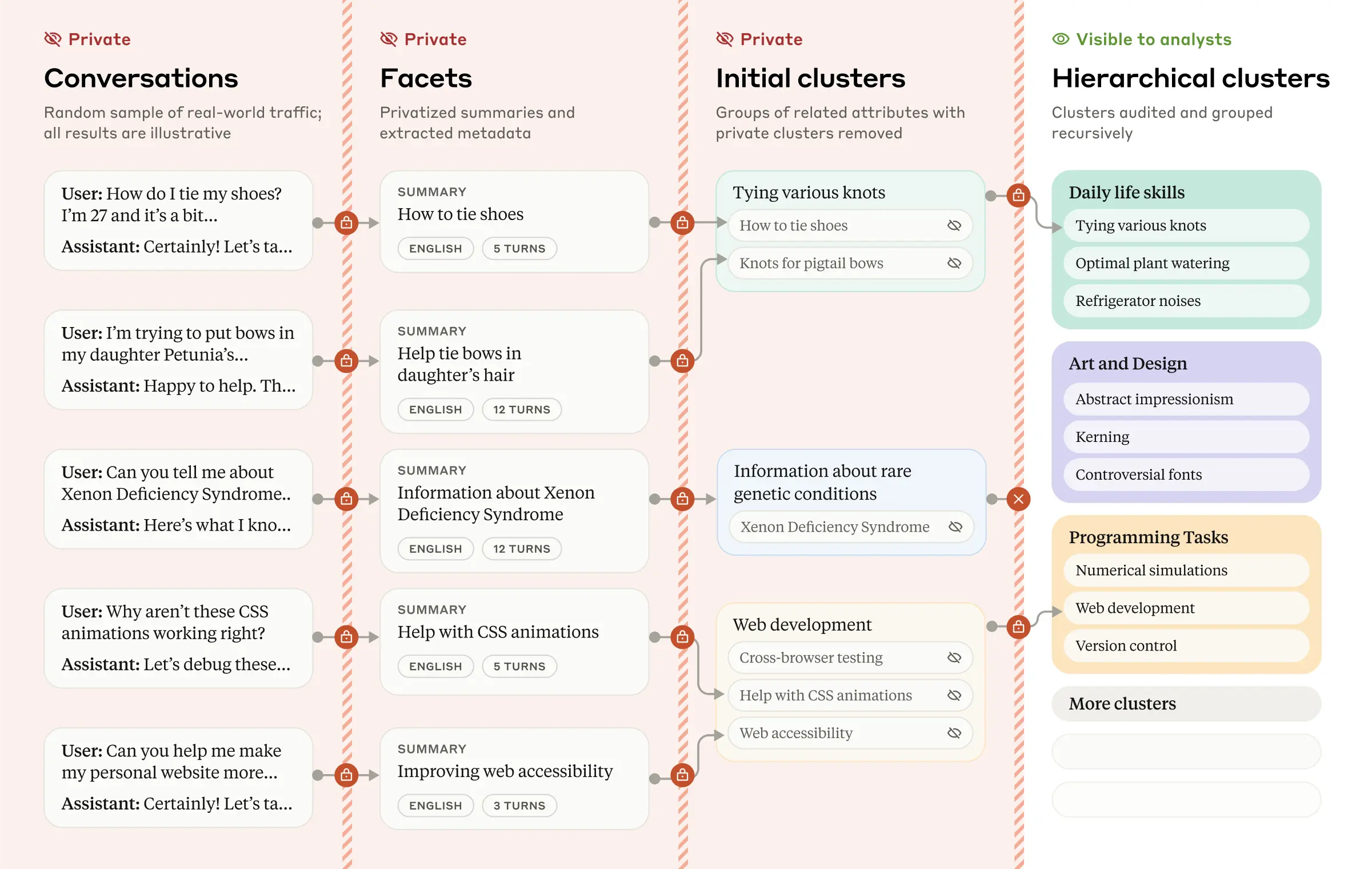
Clio processes raw user‑Claude interactions through four fully automated stages, each designed to strip identifying information before any human sees the output.
- Facet extraction – For every conversation Claude identifies metadata such as the overall topic, turn count, and language. Claude is instructed to omit any private content while extracting these attributes.
- Semantic clustering – Conversations with similar semantics are grouped together by Claude’s embedding model, forming topic clusters.
- Cluster description – Each cluster receives a concise, human‑readable title and summary that capture the common theme without leaking specifics.
- Hierarchical organization – Clusters are arranged into a multi‑level hierarchy, enabling analysts to explore patterns across dimensions like language or usage volume.
All steps are performed by Claude; humans only see the final abstract clusters. Additional safeguards include:
- Minimum‑size thresholds so low‑frequency topics (potentially identifying) are never exposed.
- A final Claude‑based verification pass that checks cluster summaries for accidental private details.
- Extensive privacy‑validation experiments documented in the accompanying research paper (see the arXiv link).
Real‑World Usage Insights from One Million Claude Conversations
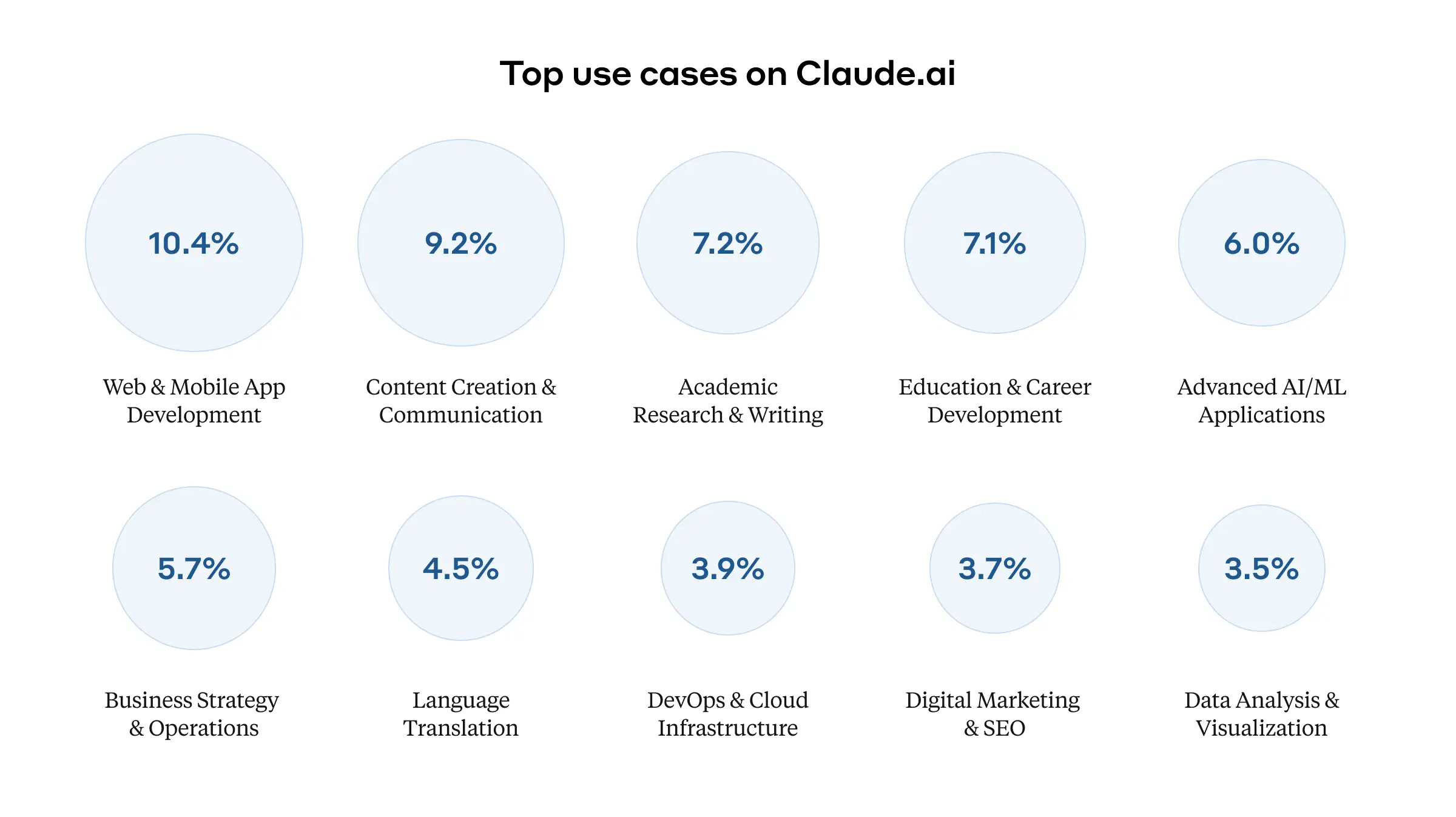
Clio examined a random sample of 1 million Claude.ai conversations (both Free and Pro tiers) and surfaced the most common high‑level use cases.
- Software development dominates, accounting for >10 % of conversations. Users ask Claude to debug code, explain Git commands, and generate snippets for web and mobile apps.
- Education follows, representing >7 % of chats, where learners seek explanations, tutoring, and problem‑solving help.
- Business strategy makes up ≈6 %, including drafting professional emails, analyzing data, and planning operations.
Clio also uncovered thousands of niche clusters, such as:
- Dream interpretation
- Soccer match analysis
- Disaster preparedness planning
- Crossword puzzle hints
- Dungeons & Dragons gaming assistance
- Counting the letter “r” in the word “strawberry”
Language‑Specific Patterns
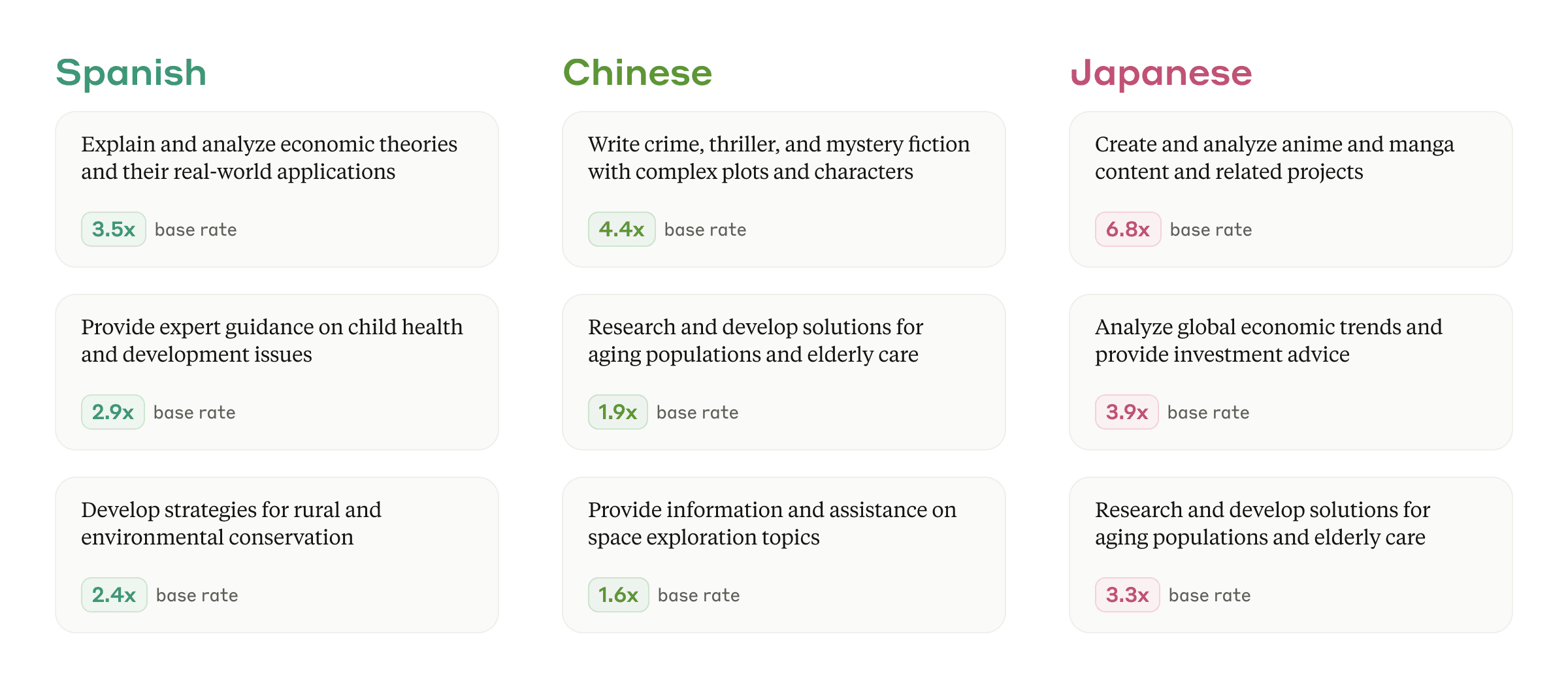
Clio measured the base frequency of each language in the dataset and identified topics that appear disproportionately often in Spanish, Chinese, and Japanese. For example, Spanish users showed a higher relative rate of conversations about travel planning, while Chinese users discussed language learning more frequently than the overall baseline.
Enhancing Trust & Safety with Bottom‑Up Discovery
Clio complements Anthropic’s existing top‑down safety methods (pre‑deployment testing, red‑team exercises) by surfacing unexpected risky patterns that would be invisible when examining individual chats.
Detecting Coordinated Abuse
In September, Clio flagged a cluster of automated accounts that used near‑identical prompts to generate SEO‑spam. Although no single conversation breached the Usage Policy, the coordinated pattern triggered removal of the entire network.
Monitoring High‑Stakes Events
During the rollout of a new computer‑use capability, Clio was used to scan for emergent harms that escaped prior testing. It also provided early warnings during the lead‑up to the 2024 US General Election, highlighting clusters around political content to enable rapid response.
Reducing False Negatives & Positives
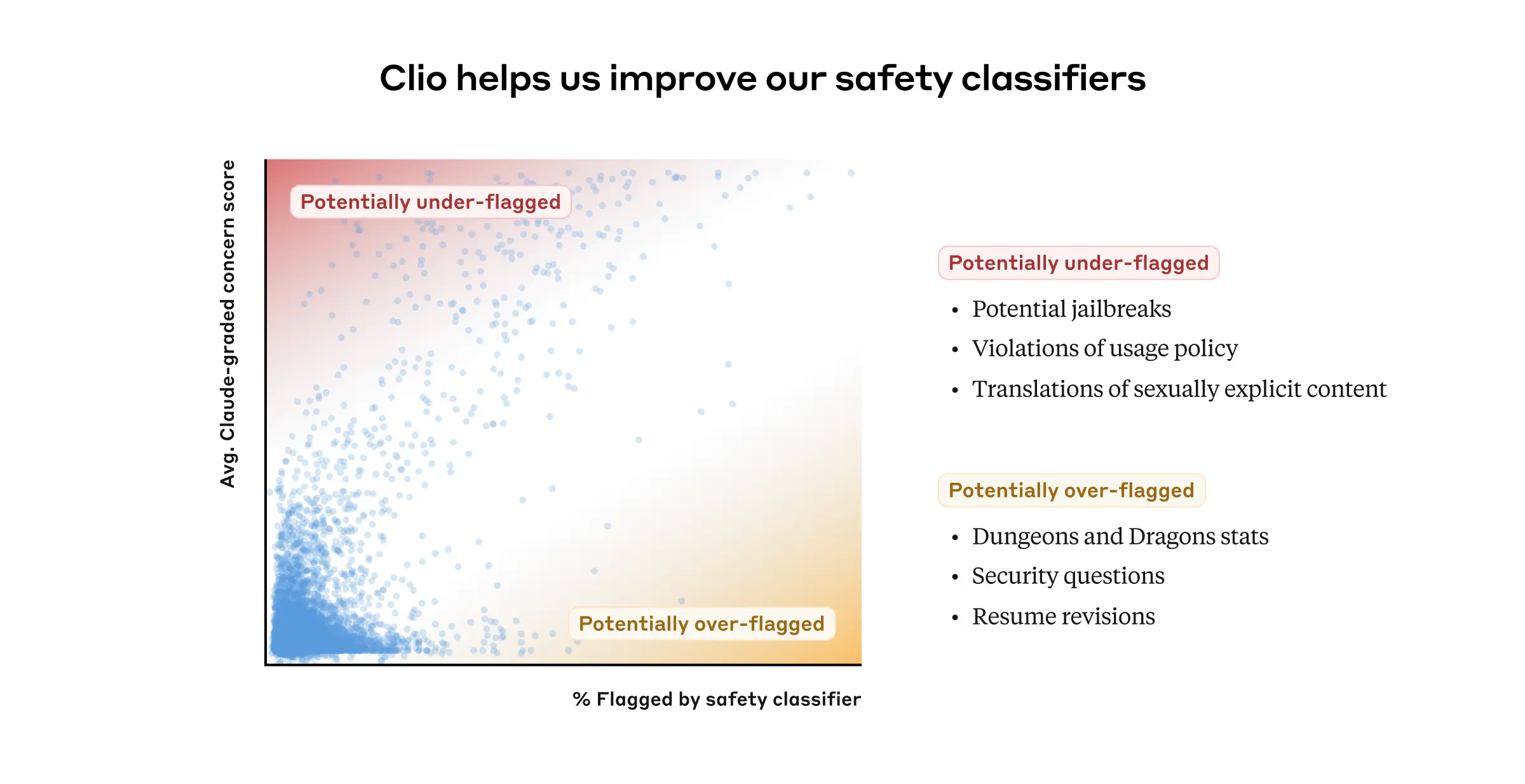
A scatterplot of cluster‑level agreement between Clio and existing classifiers shows a correlation of r = 0.71, indicating broad alignment. However, Clio identified:
- False negatives such as unflagged translations that violated policy.
- False positives where resume‑writing or D&D‑related queries were mistakenly marked harmful. These insights guided refinements that lowered unnecessary user friction while tightening genuine abuse detection.
Ethical Safeguards and Governance
Anthropic built several mitigations into Clio to address potential ethical concerns:
- No automated enforcement – Clio’s outputs are never used for direct bans; human reviewers must approve any action.
- Strict access controls – Only vetted Trust & Safety personnel can query Clio, minimizing misuse risk.
- Data minimization & retention – Only the minimal anonymized facets needed for clustering are stored, and they are regularly audited.
- Ongoing privacy audits – Continuous evaluation across languages and model updates ensures that private information does not leak.
- Transparency – Anthropic publicly disclosed Clio’s purpose, capabilities, and limitations to maintain user trust.
Conclusion: A Blueprint for Privacy‑Preserving Safety Analytics
Clio demonstrates that large‑scale usage analytics and strong privacy guarantees can coexist. By turning raw Claude interactions into abstract, human‑readable clusters, Anthropic gains actionable safety signals while respecting user confidentiality. The system has already uncovered coordinated abuse, refined false‑positive handling, and provided real‑time monitoring during politically sensitive periods. As the research paper details, Clio’s design offers a reproducible template for other AI providers seeking empirically grounded, privacy‑first governance tools.
For full technical details, see the full research paper.
Sources
Related
- Dispatch
- Dispatch
- Dispatch
- Dispatch
- Dispatch