Anthropic Claude Opus 4.7 chemistry release: NMR prediction and structure elucidation
TL;DR
Claude Opus 4.7 matches or exceeds the forward‑prediction accuracy of dedicated NMR tools such as ChemDraw and MestReNova, and it can also propose correct molecular structures from 1D NMR spectra and molecular formulas, demonstrating that a general‑purpose LLM is now competitive in routine spectral analysis.
Why NMR matters for chemistry
Chemists rely on NMR spectroscopy to infer molecular structures because most small molecules cannot be visualized directly. Interpreting an NMR spectrum requires matching each peak to a specific atom, a labor‑intensive step that slows synthetic research. Automating this step would accelerate drug discovery, materials design, and many other fields that depend on rapid structure verification.
Forward prediction performance
Conclusion: Opus 4.7 achieves the lowest mean absolute error (MAE) for ¹H shifts (±0.079 ppm) and is on par with MestReNova for ¹³C shifts (±1.37 ppm), outperforming older Claude models and matching dedicated software.
- Benchmark set: 20 novel compounds from post‑cutoff ChemRxiv preprints, covering four scaffold families that each present a distinct NMR challenge.
- Method: Each tool received a SMILES string and solvent information, then predicted the full ¹H and ¹³C spectra. Claude models were queried three times per compound; results were averaged.
- Error metrics: Peaks were considered correct if they fell within ±0.20 ppm (¹H) or ±1.0 ppm (¹³C). Opus 4.7 placed the highest proportion of peaks inside these windows.
- Peak shape & splitting: Beyond chemical‑shift accuracy, Opus 4.7 reproduced experimental splitting patterns more often than ChemDraw or MestReNova, and predicted sub‑peak spacing within half a hertz ~80 % of the time (vs. 26‑35 % for the classical tools).
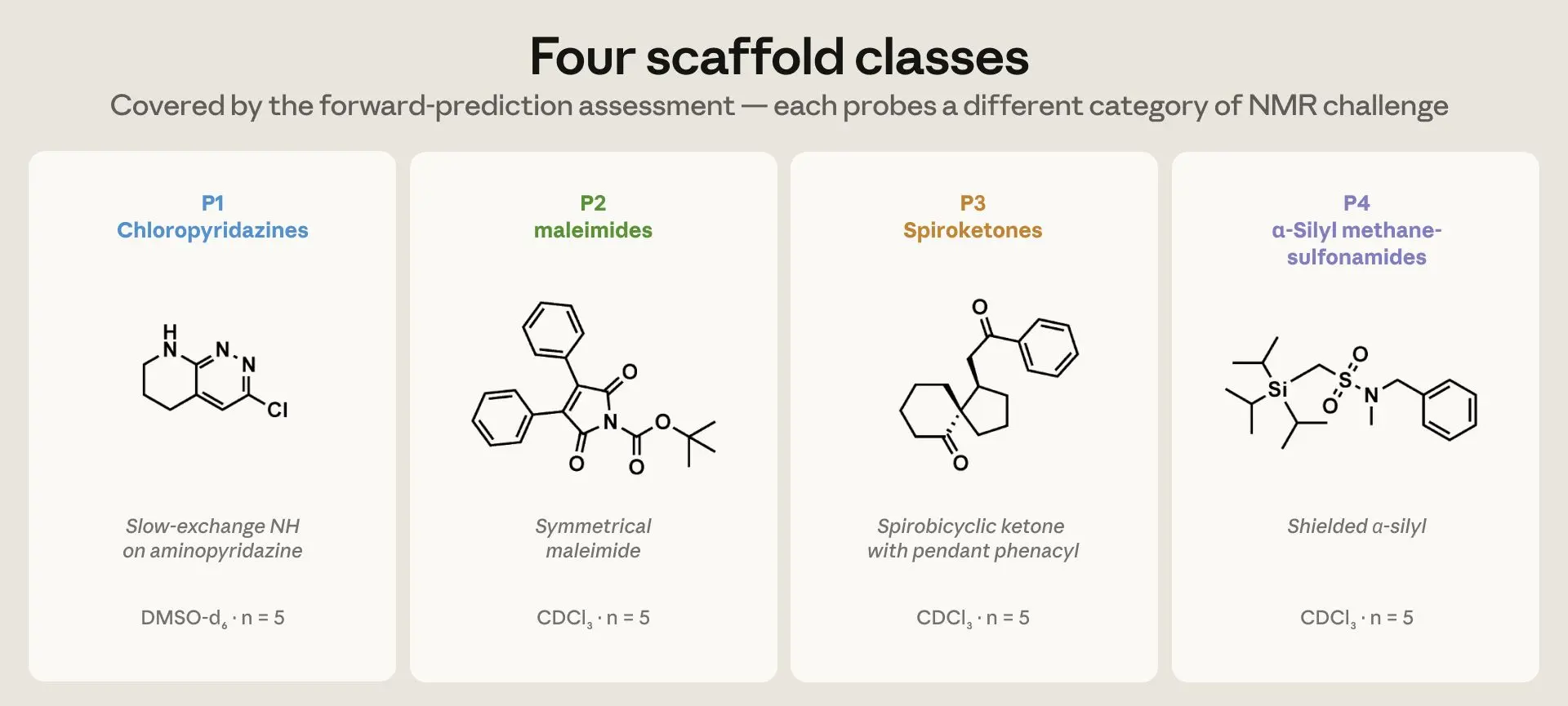 Figure 1. Scaffold families selected to probe different NMR challenges.
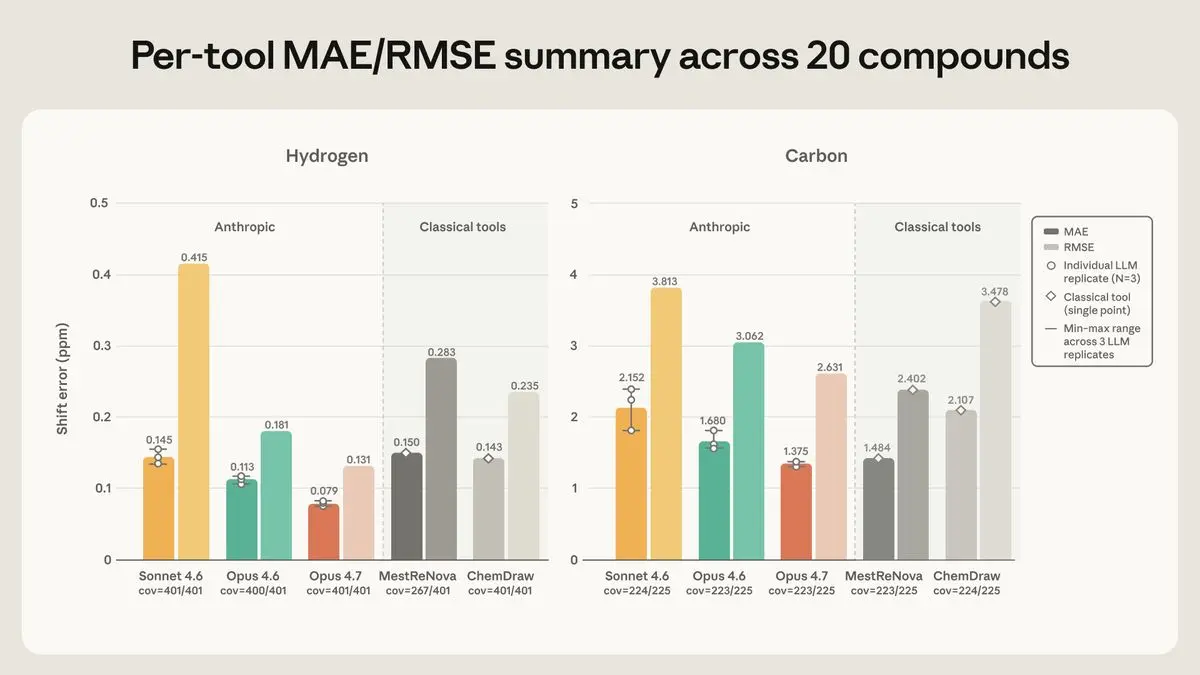 Figure 2. Mean absolute error (dark) and root‑mean‑square error (light) for ¹H (left) and ¹³C (right) shifts across tools.
Inverse prediction (structure elucidation)
Conclusion: Opus 4.7 correctly identified all eight simple molecules from spectra and formula alone, and solved four of seven more complex targets on every run when given the starting‑material SMILES as an additional hint.
- Task design: 15 literature compounds were presented with their exact molecular formula, ¹H and ¹³C spectra, and for the seven hardest cases also the SMILES of the reaction’s starting material.
- Output: For each problem Claude returned up to three ranked candidate structures, queried three times.
- Results: Simple targets (single‑ring or two‑fragment) were solved 100 % of the time. For dense targets, success rates were 100 % (four compounds) or 66 % (two compounds) when the starting‑material context was provided.
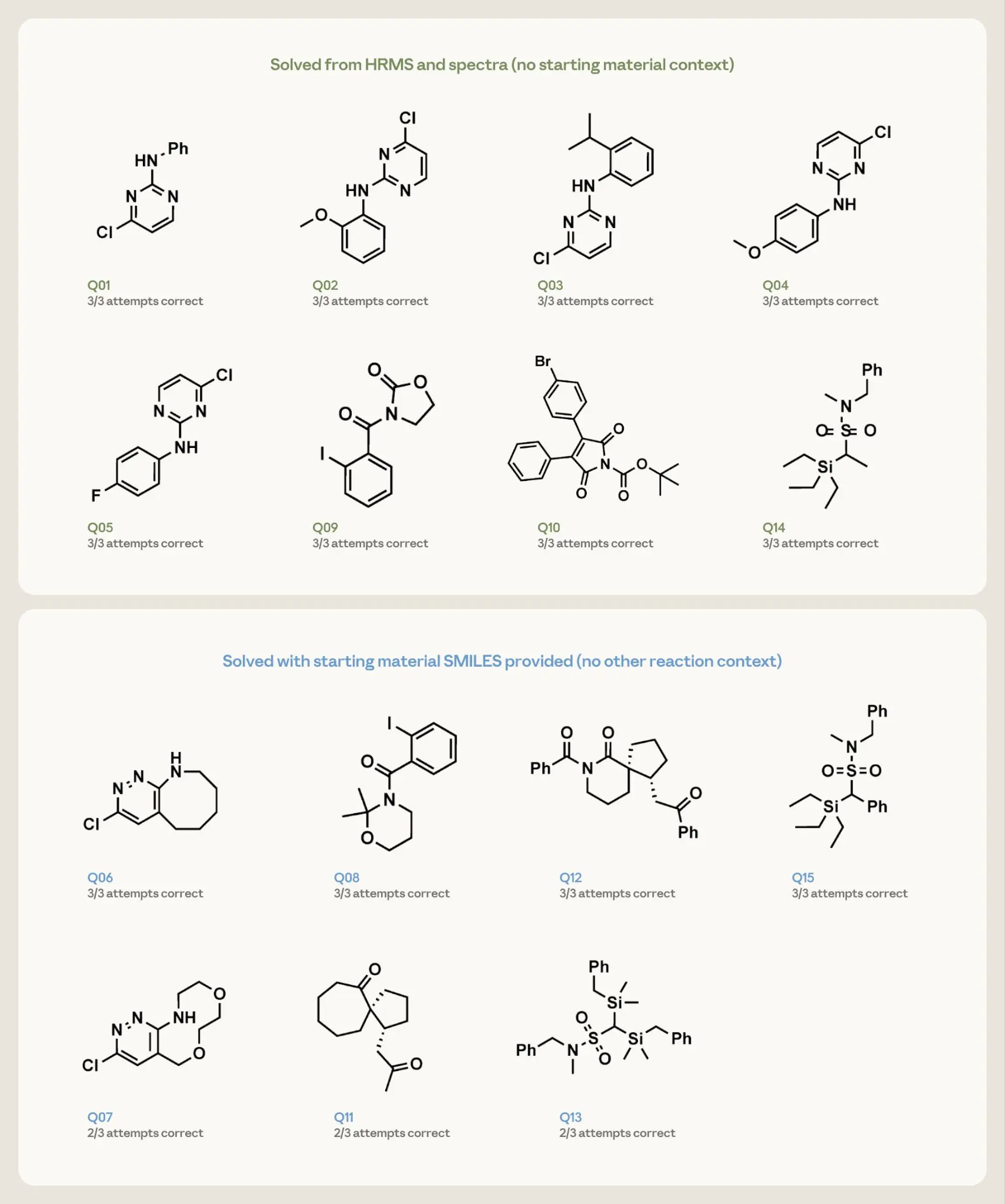 Figure 3. Success counts for each inverse‑prediction problem; green borders = spectra + formula only, blue borders = spectra + formula + starting‑material hint.
Limitations of the current study
Conclusion: The benchmark is small and narrowly scoped, so results should be viewed as indicative rather than definitive.
- Dataset size: Only 20 forward‑prediction and 15 inverse‑prediction compounds were tested, each representing a single scaffold class.
- Input constraints: The hardest inverse tasks required the starting‑material SMILES; without that hint the model struggled to converge on a single structure.
- Chemical diversity: Certain heteroaromatic NH systems, stereochemical information, and 2D NMR experiments (COSY, HSQC, HMBC) were not evaluated.
- Solvent coverage: Tests were limited to DMSO‑d₆, CDCl₃, and D₂O; other common deuterated solvents remain unassessed.
- Scalability: Performance on hundreds of compounds across 20–30 scaffold families remains an open question.
Future roadmap for Claude in chemistry
Conclusion: Anthropic will prioritize four bottlenecks—structure digitization, reaction reasoning, mechanistic explanation, and literature comprehension—to broaden Claude’s utility beyond spectral analysis.
- Structure extraction: Convert hand‑drawn sketches, patent figures, and slide images into machine‑readable formats (SMILES, InChI) and generate systematic IUPAC names.
- Synthetic planning: Propose, evaluate, and critique synthetic routes, including reagent selection, selectivity predictions, and by‑product forecasting.
- Mechanistic insight: Explain reaction pathways with electron‑pushing arrows, intermediate structures, and transition‑state rationales in chemist‑friendly language.
- Literature mining: Parse method sections, supporting information, and patents to retrieve relevant chemical data regardless of naming conventions or graphical representations.
These areas are at varying stages of maturity; spectral analysis is the most mature and thus the first to be benchmarked, while retrosynthesis and mechanistic reasoning are still being scoped.
How to collaborate
Anthropic is expanding its AI for Science program to support chemistry projects that can benefit from Claude’s multimodal reasoning. Researchers interested in partnering can apply via the program page or contact scienceblog@anthropic.com.
References
Sources
- OriginalMaking Claude a chemist
Related
- Dispatch
- Dispatch
- Dispatch
- Dispatch
- Dispatch