OpenAI gpt-oss-safeguard models released via Ollama
TL;DR
OpenAI, Ollama, and ROOST announced the open‑source gpt-oss-safeguard models (20 B and 120 B parameters) under an Apache 2.0 license, providing a reasoning‑based safety classifier that can interpret arbitrary user‑defined policies and expose its chain‑of‑thought decisions.
Model Availability and Licensing
Takeaway: The models are freely downloadable, runnable via Ollama, and carry a permissive Apache 2.0 license, removing copyleft and patent concerns for commercial or experimental use.
- Two model sizes are offered:
gpt-oss-safeguard:20bandgpt-oss-safeguard:120b. - Installation steps are simple: download Ollama, then run
ollama run gpt-oss-safeguard:20b(or:120b). - Apache 2.0 licensing allows unrestricted modification, redistribution, and commercial deployment.
Core Technical Features
Takeaway: The models are purpose‑built for safety reasoning, supporting custom policies, transparent reasoning output, and adjustable inference effort.
Safety‑Focused Training
- Trained and fine‑tuned explicitly to reason about safety classification tasks such as input‑output filtering, online content labeling, and offline trust‑and‑safety pipelines.
Bring‑Your‑Own‑Policy (BYOP)
- The model accepts a textual policy description at inference time and applies it across diverse products without additional engineering.
Reasoned Decisions Instead of Raw Scores
- Returns a full chain‑of‑thought (CoT) explanation, enabling developers to debug and audit decisions.
- The raw CoT output is intended for safety practitioners, not end‑users.
Configurable Reasoning Effort
- Users can select low, medium, or high reasoning effort, trading off latency against depth of analysis.
Evaluation Results
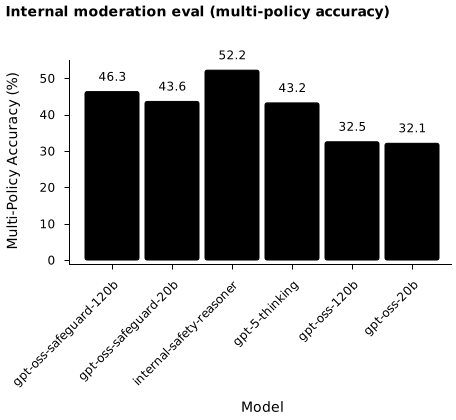
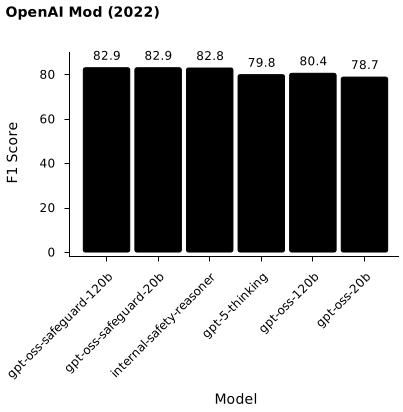
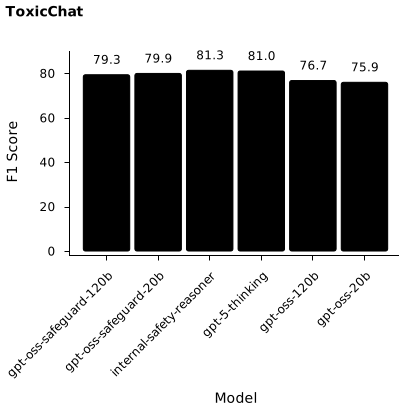
Takeaway: OpenAI’s internal and external benchmarks show that gpt‑oss‑safeguard accurately classifies text against multiple simultaneous policies and performs competitively on established moderation datasets.
- Internal Multi‑Policy Test: Accuracy is measured only when the model’s label matches the gold set for all supplied policies, a stringent criterion.
- OpenAI Moderation Dataset (2022): The models were evaluated on the same dataset released with OpenAI’s 2022 moderation research paper.
- ToxicChat Benchmark: Performance was also measured on the public ToxicChat benchmark, which reflects real‑world user queries to open‑source chatbots.
Community and Organizational Context
Takeaway: The release is backed by ROOST, a non‑profit dedicated to open‑source safety tooling, underscoring a broader movement toward transparent, community‑driven AI safety infrastructure.
“gpt‑oss‑safeguard is the first open source reasoning model with a ‘bring your own policies and definitions of harm’ design. Organizations deserve to freely study, modify and use critical safety technologies and be able to innovate. In our testing, it was skillful at understanding different policies, explaining its reasoning, and showing nuance in applying the policies, which we believe will be beneficial to builders and safety teams.” – Vinay Rao, CTO of ROOST
About ROOST
- ROOST (Robust Open Online Safety Tools) is a 2025‑founded non‑profit that supplies high‑quality, open‑source safety tools to digital organizations.
- It is supported by a coalition of technology companies, philanthropic groups, and academia.
Getting Started Resources
Takeaway: Developers can follow official guides and community repositories to integrate the models into their pipelines.
- OpenAI blog post: https://openai.com/index/introducing-gpt-oss-safeguard/
- Developer cookbook: https://cookbook.openai.com/articles/gpt-oss-safeguard-guide
- ROOST model community repo: https://github.com/roostorg/open-models
Implications for the AI Safety Landscape
Takeaway: By releasing a high‑capacity, policy‑driven safety model under a permissive license, OpenAI and its partners lower the barrier for organizations to implement robust content moderation, potentially accelerating the adoption of responsible AI practices across industry and research.
- The BYOP design reduces the need for bespoke safety model training, saving resources for smaller teams.
- Transparent reasoning fosters trust and facilitates regulatory compliance where explainability is required.
- Open licensing encourages community audits, extensions, and integration with diverse ecosystems, mitigating the risk of vendor lock‑in.
Sources
- OriginalOpenAI gpt-oss-safeguard
Related
- Dispatch
- Dispatch
- Dispatch
- Dispatch
- Dispatch