✷ ハーネス
Choosing an open-source coding agent: agent, workbench, or skill pack?
Three things get sold under one name. They don't substitute for each other, and mixing them up is why every shortlist you build feels wrong.
この記事はまだ日本語版がありません。英語の原文を表示しています。
If you only want this week's attention ranking, the topic board has it, and Orca is missing from that edition for reasons in section 5. If you want to pick a class first, read on.
1. The category blur is the default
OpenAlternative publishes "Open Source AI Coding Agents in 2026: The 12 Worth Using". One section is called "What counts as an open source AI coding agent", and it draws the lines: an agent runs a loop, an assistant completes code inside the editor, and an orchestrator sits a level above to run several agents (this piece calls that a workbench).
The list then includes Goose, "a general-purpose agent with a strong coding side"; Open Interpreter, which "started as a general 'let the LLM run code on your computer' project"; OpenHands, "half agent and half orchestrator"; and Zed, an editor.
It separates the categories in one section and mixes them in the next. The word covers all of it, and the search box only accepts the word.
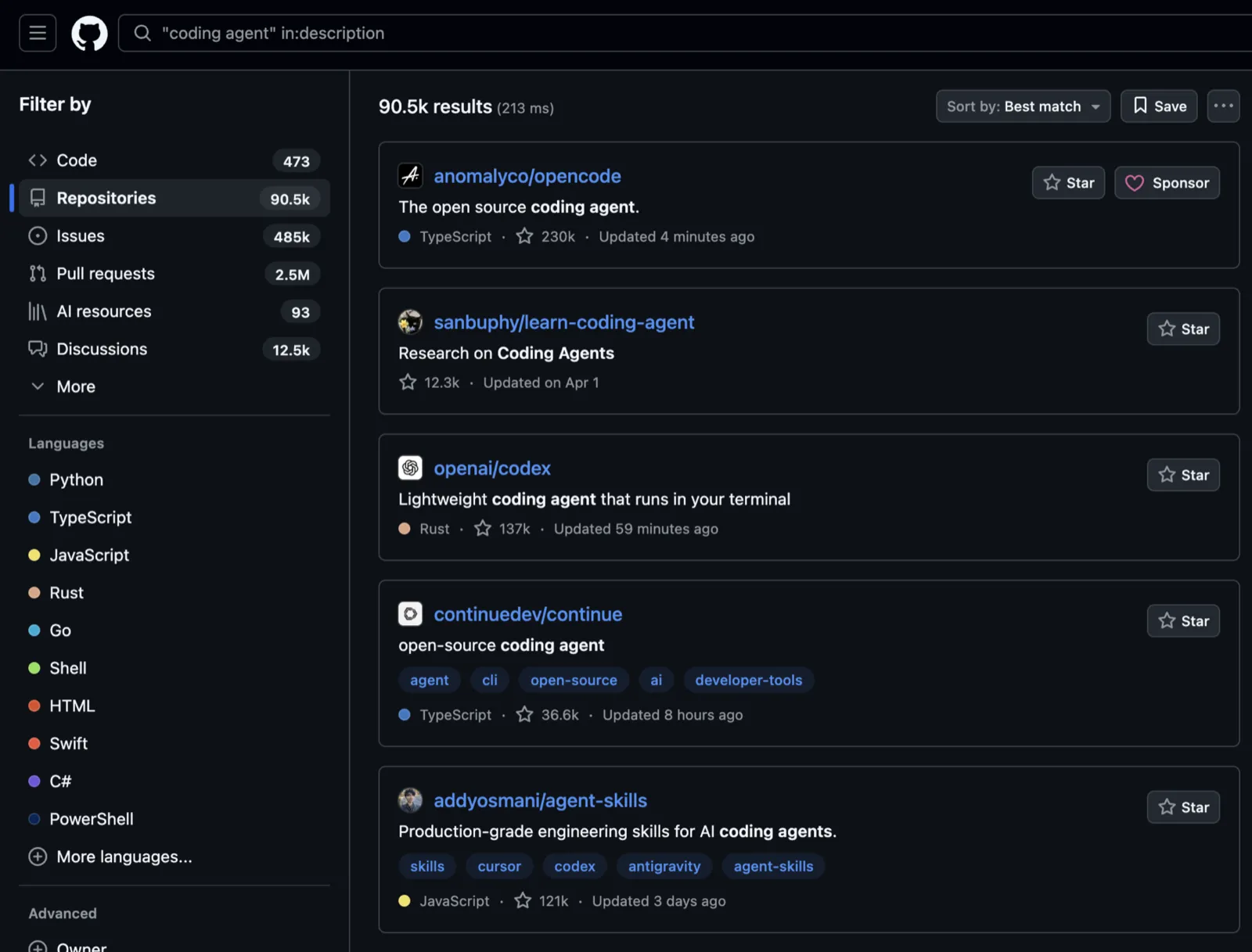
GitHub shows how far the blur reaches. On 2026-11-27, "coding agent" in:description returned 90,454 repositories, and "ai agent" in:description returned 397,222.
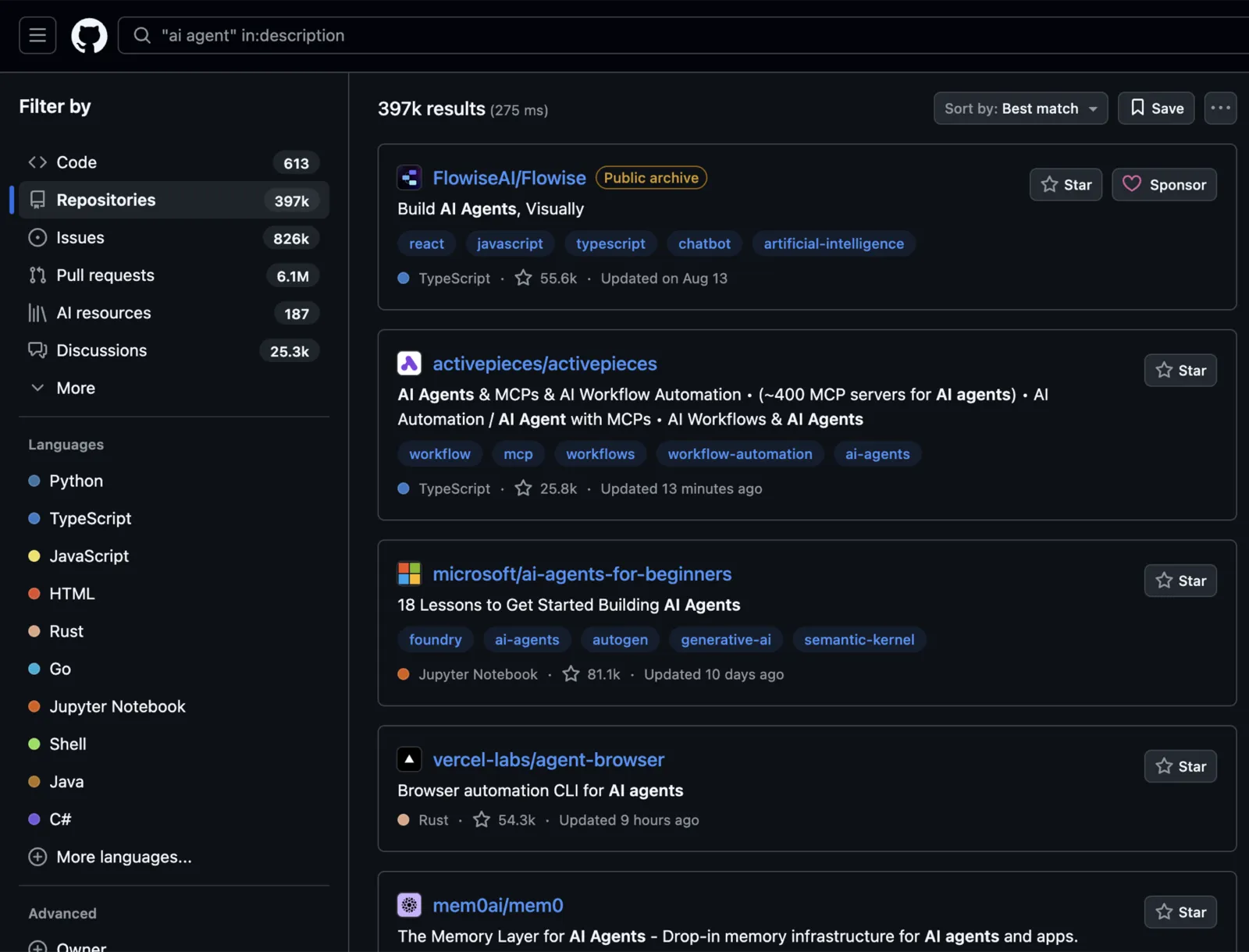
The first five results for "ai agent" are a visual agent builder, a workflow automation tool, an eighteen-lesson tutorial, a browser automation CLI, and a memory layer. None of them opens a terminal and edits your files.
The word describes a genre, and the loop still separates products.
This piece covers open-source tools only: things you install and read yourself. Closed commercial agents sit outside this question.
2. One counterexample
obra/superpowers has 327,559 stars and describes itself as "An agentic skills framework & software development methodology that works." The word agentic sits in the first sentence. What ships is a set of skills and a way of working: you install it into an agent you already run, and that agent changes how it works. The loop underneath stays where it was.
The sharp line is the loop. A skill pack adds material to a loop somebody else wrote. An agent owns its loop: the model call, the tool call, the stop condition, and the step that feeds the result back.
A repository description answers a different question than the one you're asking. The loop answers "can this thing edit my files and run my tests without me."
3. Two sets of three questions
Agent:
- Can it edit files in my workspace?
- Can it run commands or tests?
- Do I sign off on what it produced?
Workbench:
- Does it start agents I already installed?
- Can I watch each task, with diffs?
- Who merges?
The sets don't transfer. t3code controls Claude Code and Codex from another computer or a phone, and the tests run on the machine hosting those agents. Score t3code with the agent questions and it fails all three, which tells you nothing, because it never claimed to run tests.
Picking a class takes one question about your week. Several tasks in parallel with a phone in reach points to a workbench. One agent in one terminal on one repo points to an agent. Plenty of people want both, and the honest answer is one of each.
4. What to check inside each class
The questions above filter. These decide which one you install.
Agent:
- Context: does it scan the repository, or wait for an
AGENTS.mdyou maintain? - Tests: can it run them and read the failures back?
- Models and keys: a bundled subscription, or your own key?
- Reversal: branch or worktree isolation, so a bad run costs one command?
Workbench:
- The agents it drives: the CLIs you already have, or a subscription it sells?
- Isolation: worktrees, containers, or one directory taking turns?
- Progress: diffs and test output, or a status word?
- Merge: your hands, or the tool's?
Skill pack:
- The agent it binds to.
- Whether it still ships.
- Whether it produces something checkable, a test command or a checklist, instead of prose.
Same class, different shape
pi ships an "AI agent toolkit: unified LLM API, agent loop, TUI, coding agent CLI". The loop and the tool calls arrive as parts, so you can embed them. opencode ships a finished agent: two switchable agents, build and plan, plus a beta desktop app. Pick pi when the loop has to live inside your product. Pick opencode when you want to install something and start.
Orca gives every task its own git worktree and drives the CLI agents you installed. t3code takes those same agents to another screen, phone included. Orca separates the work. t3code moves the entrance.
A feature table hands you ticks and crosses. It won't tell you which row matches your week.
By the classification in this piece, six of the ten rows on this edition are workbenches.
5. Then the question of who is rising
SoduWork gained 98% in a week, from 4,156 stars to 8,233. t3code gained 21.9%, from 66,369 to 80,896, about 2,074 stars a day.
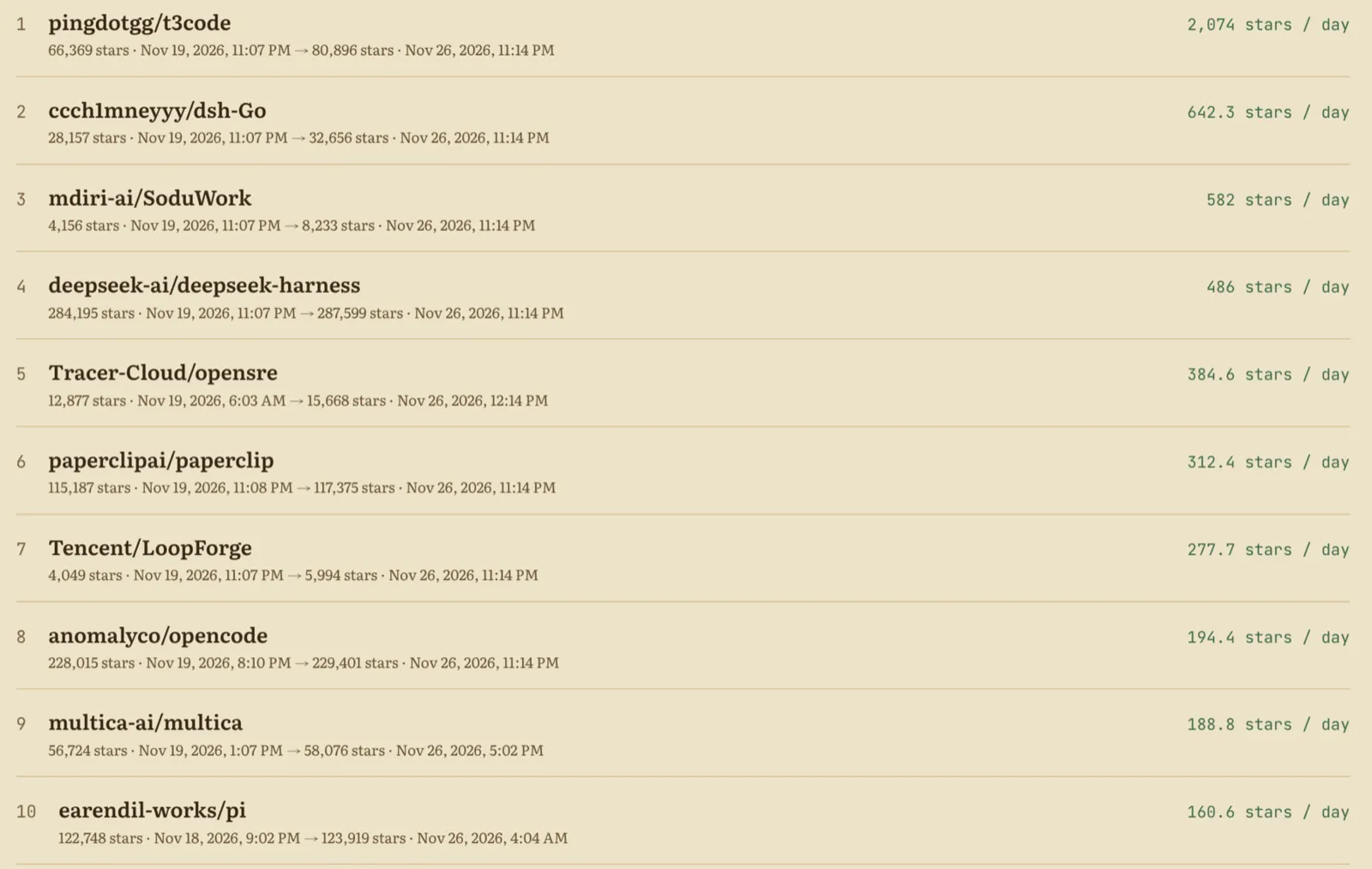
By relative growth SoduWork leads all ten rows. On the board it ranks third, because the board sorts by stars per day: t3code added 14,527 stars that week, more than SoduWork's entire population.
Stars per day measures attention. It says people are discussing the thing, and says nothing about whether it fixes your code. The diffs in your repo answer that.
Orca has 141,000 stars and doesn't appear in this edition. The board froze before Orca was ingested, and a frozen edition takes no late entries. Read it as the record of one week, not as a live ranking.
Take the three questions to the tool you're using now. If one question has no answer, you're holding a different class of thing, and the other set of questions applies.
Sources
- GitHub repository search:
"coding agent" in:descriptionreturned 90,454 and"ai agent" in:descriptionreturned 397,222 on 2026-11-27. Those are the API counts; the screenshots show GitHub's rounding (90.5k, 397k). - Mixed categories: openalternative.co/blog/best-open-source-ai-coding-agents, cited for its category section and the composition of its list.
- Ranking data: AgentLensHQ coding agent and workbench board, frozen edition
2026-11-27.r1,ruleVersion coding-agent-tool-v1. Row windows start between 11/18 and 11/19. Percentages are computed from each row's start and end star counts; the page itself publishes stars per day. - Project quotes come from repository descriptions and READMEs, read on 2026-11-27.