Falcon 9 Upper Stage 2025-010D Predicted Moon Impact on 2026‑08‑05
What is hitting the Moon?
The object is the upper stage of a Falcon 9 launch (catalog 2025‑010D). It was the fourth tracked piece from the 15 January 2025 launch that carried the Blue Ghost and Hakuto‑R lunar landers. The stage has a mass of about 4 900 kg and a height comparable to a five‑story building.
Who tracked the stage?
Because the stage orbits near the Moon’s distance, radar tracking is ineffective; instead, asteroid‑survey telescopes and amateur observers recorded 1 053 observations from sites in Mississippi, Utah, Beijing and England. The data are publicly available in the Minor Planet Electronic Circulars linked on the Project Pluto page.
How was the impact forecast?
Using publicly released US‑SPACETRACK two‑line element sets and custom orbit‑determination software, the author computed the trajectory. Gravity from Earth, Moon, Sun and planets is well known, but solar radiation pressure (SRP) introduces uncertainty because the tumbling stage reflects sunlight unevenly. As of 17 July 2026 the prediction is accurate to a few seconds in time and a few kilometres in position, with the dominant error coming from SRP.
Predicted impact time and location
- UTC: 2026‑08‑05 06:34:32.9 ± a few seconds
- Lunar coordinates: 19.455° N, 266.406° E (93.594° W)
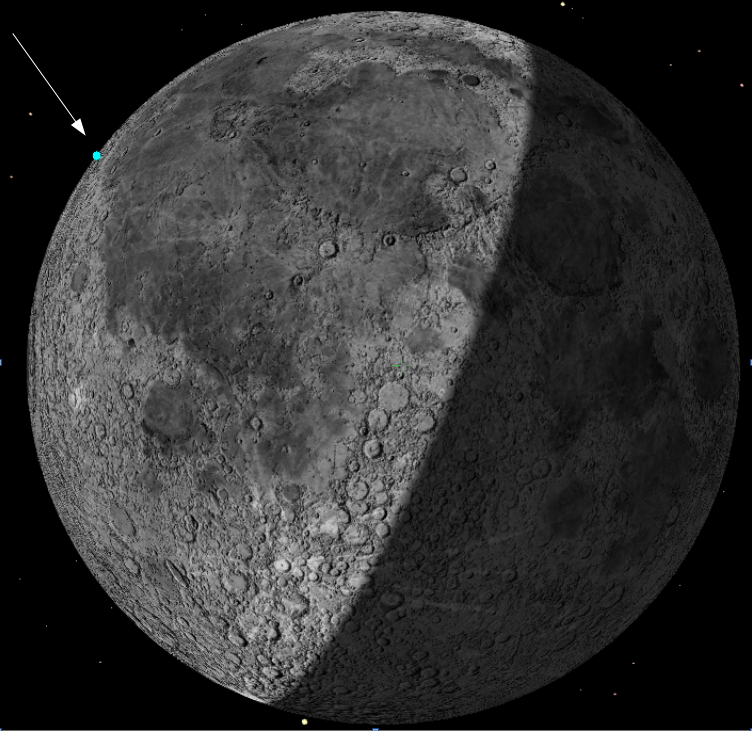
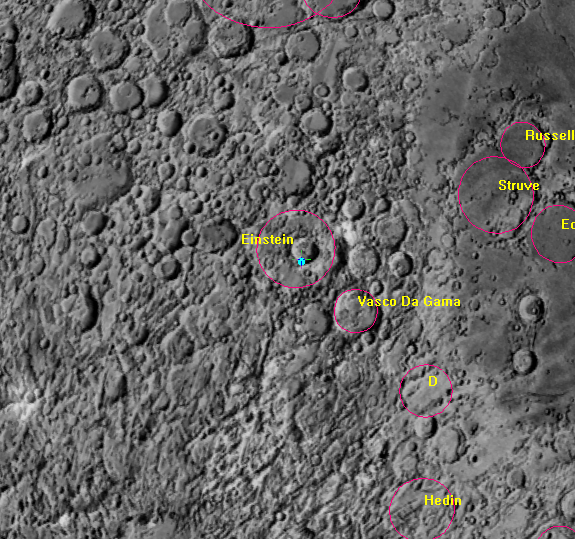
- Near‑side limb: The site lies close to the Moon’s edge as seen from Earth, just east of crater Einstein.
The impact point is shown on the lunar map below (blue circle‑cross):
A close‑up view from directly above:
Physical characteristics and spin
The stage’s dimensions are known from Falcon 9 specifications. Light‑curve measurements by Grant Privett (UK) and Jean‑François Gout show a ~3‑minute rotation period, indicating a tumbling motion that affects SRP.

Impact velocity and energy
- Speed at impact: 2.43 km s⁻¹ (≈ Mach 7 in air, though there is no atmosphere on the Moon).
- Kinetic energy: ½ mv² ≈ 1.45 × 10¹⁰ J, equivalent to ~15 000 sticks of dynamite or ~3 t TNT.
Because the velocity is modest compared with typical meteoroids (10–70 km s⁻¹), only a small fraction of this energy will appear as visible light.
Will the flash be visible?
The impact occurs a week after full Moon, on the sunlit near side, so the Moon will be high in the sky for observers in the Americas and western Europe. However, the low impact speed means the flash is likely too faint to be seen with the naked eye or modest telescopes. Some observers suggest that a plume of ejecta rising above the limb could become detectable with high‑resolution imaging, but the expected angular separation (~1.5 arcsec) makes detection challenging.
Expected crater size
Based on the Chang’e‑5 T1 upper‑stage impact (two 17 m craters), the 4.9‑ton stage should produce a single crater ~17 m in diameter and ~2 m deep, excavating roughly 450 m³ of regolith (1 100 t). Ejecta velocities are estimated at ~100 m s⁻¹, allowing material to reach heights of a few kilometres before falling back.
Post‑impact observations
The Lunar Reconnaissance Orbiter (LRO) routinely images new impact sites. Given the precise predicted coordinates, LRO teams can target the area and should capture the fresh crater within weeks to months after impact.
Why this matters
- Scientific opportunity: Artificial impacts let researchers calibrate crater‑formation models and study ejecta dynamics under known conditions.
- Space‑debris awareness: The event underscores the lack of end‑of‑life disposal for high‑energy lunar mission stages. While a Moon impact poses negligible risk to Earth, similar debris re‑entering the atmosphere contributes to upper‑atmosphere pollution and collision hazards.
- Policy relevance: The incident highlights the need for clearer regulations on disposal of lunar‑bound upper stages, similar to the emerging “end‑of‑life disposal” guidelines being discussed by ESA and other agencies.
Community reaction (Hacker News highlights)
- Users praised the page’s simple HTML design, noting its lack of ads and scripts.
- Several commenters expressed concern over SpaceX’s “carelessness” in leaving hardware that eventually reaches the Moon.
- Questions were raised about the remaining propellant in the stage; the author notes that most fuel would have been expended during the trans‑lunar injection, leaving only residuals.
- A few participants suggested creating a Discord channel for live tracking, while others called for stricter liability for space junk.
How to follow the event
- Ephemeris services: Use the Project Pluto satellite ephemeris tool or NASA JPL’s Horizons system (target 2025‑010D) to obtain real‑time sky coordinates.
- Amateur imaging: Observers should capture the limb region before, during, and after the predicted impact time, using high‑frame‑rate video and image stacking to maximize the chance of detecting a flash or plume.
- Professional assets: LRO and other lunar orbiters will likely acquire high‑resolution imagery of the new crater within weeks.
All information is drawn from the public‑domain Project Pluto page (https://www.projectpluto.com/25010d.htm) and the linked news articles. No facts have been invented beyond what the source provides.