Claude accelerates open‑source biomolecular models 4× faster and enables >10k‑token predictions on a single GPU
TL;DR
Anthropic released a suite of Claude‑driven optimizations that make over 30 open‑source biomolecular modeling tools roughly four times faster on average, cut memory use enough to predict structures larger than 10,000 tokens on a single NVIDIA GPU, and announced a $1 million protein‑design competition co‑sponsored with Adaptyv Bio.
Claude‑powered inference acceleration
Key result: Claude accelerated 30+ deep‑learning models for structure prediction, protein design, protein language modeling, and genomics, achieving an average 4× speed‑up with minimal precision loss (≈1.6× speed‑up with identical outputs). The work was completed in under four weeks, a task that normally requires weeks of engineering per model.
- Claude acted as a general‑purpose research model, guided by two Anthropic staff members with domain expertise but no prior kernel‑engineering experience.
- Optimizations included custom kernels for triangle attention and multiplication (FlashPairformer), caching of redundant work, and pruning of dead code paths.
- The accelerated models retained downstream performance on tasks such as protein structure prediction.
"Claude accelerated over a dozen biomolecular structure prediction models, achieving, on average, a roughly 4× speed‑up with minimal decrease in precision and a roughly 1.6× speed‑up with identical outputs." – Anthropic blog post
FlashPairformer: custom kernels for triangle operations
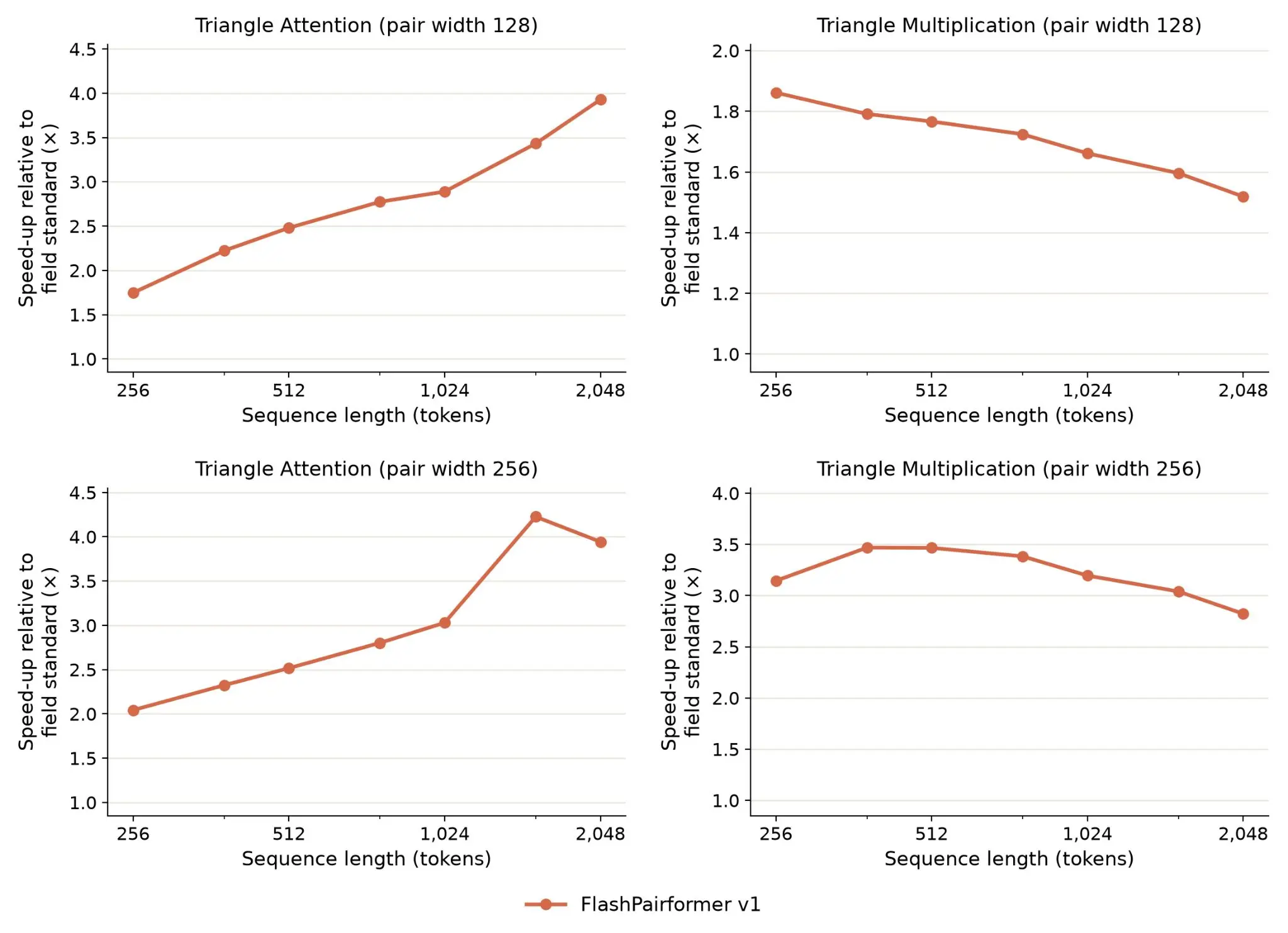
Key result: FlashPairformer, a set of Claude‑generated kernels, outperforms the field‑standard cuEquivariance implementation by 2.7–2.9× on triangle attention and 1.7–3.2× on triangle multiplication, depending on model configuration.
- Triangle attention and multiplication dominate runtime and memory in AlphaFold‑class models because they scale cubically with token count.
- By rewriting these kernels, Claude achieved state‑of‑the‑art performance for the core Pairformer architecture.
Low‑memory “Big” mode for massive biomolecular systems
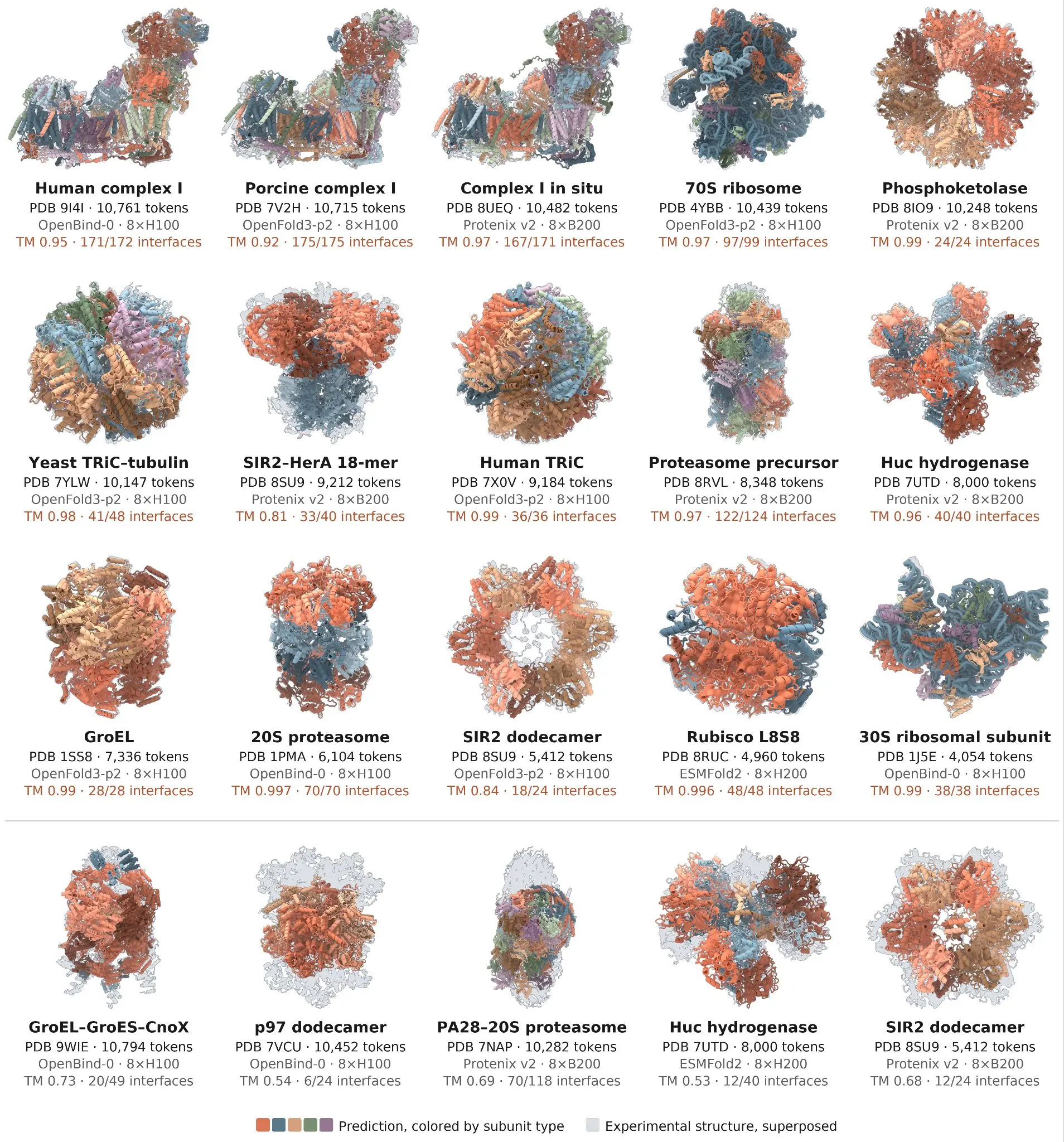
Key result: Claude introduced a low‑memory “Big” mode that enables accurate inference for systems >10,000 tokens on a single NVIDIA GPU node and successful inference for systems up to 70,000 tokens on one B300 node.
- Demonstrated accurate predictions for human mitochondrial complex I, the TRiC chaperone, a proteasome, and a bacterial ribosome (each >10,000 tokens).
- Compared to AlphaFold 3’s 7,663‑token 40S ribosome prediction, Claude’s Big mode pushes the size frontier by ~1.5 orders of magnitude.
- When pushed to 31,000–70,000‑token viral capsids and protein compartments, predictions collapsed, indicating a lack of generalization far beyond the training context, but the computational barrier was dramatically lowered.
Efficient de novo protein binder design
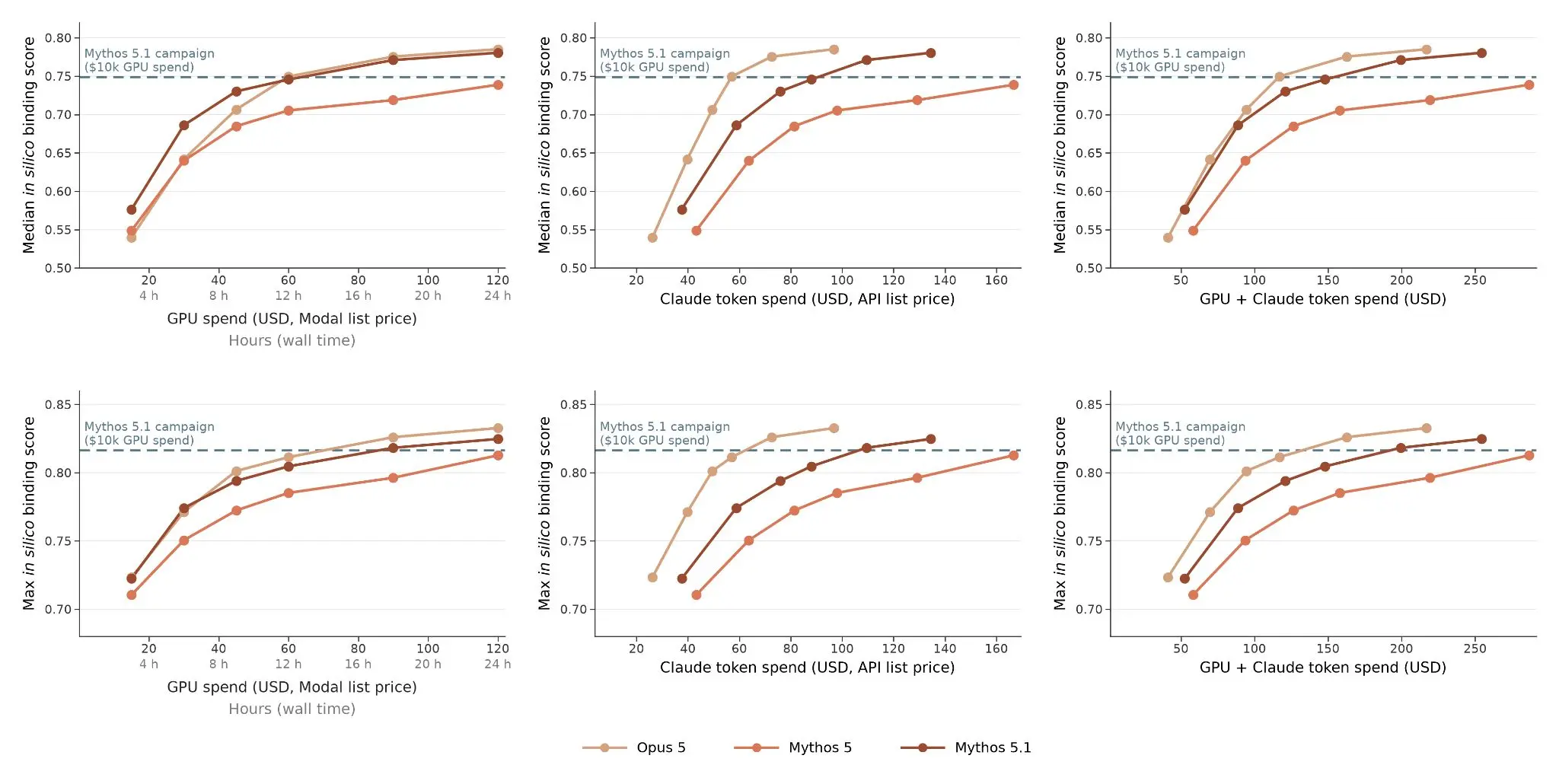
Key result: Using a single Claude model on one NVIDIA H200 GPU for 24 h, Anthropic reproduced the in‑silico binding scores of its earlier Mythos 5.1 campaigns while spending roughly 100× fewer GPU hours and about $150 in total GPU + token costs.
- Three Claude variants (Mythos 5.1, Mythos 5, Opus 5) were evaluated on 16 targets.
- Median and top ipSAE scores matched those of the prior multi‑agent, $10 k‑per‑target experiments.
- This demonstrates that Claude’s accelerated biomolecular stack can deliver comparable design quality with dramatically reduced compute budgets.
Open‑source release and community competition
- All optimized code for the 30+ models is available at https://github.com/anthropics/uplifting-biomolecular-modeling.
- A detailed technical report (PDF) provides benchmarking methodology and full results.
- Anthropic and Adaptyv Bio are co‑sponsoring a protein‑design competition with up to $1 M in Claude credits, $250 k in Modal compute credits, and wet‑lab validation for >5,000 designs. The competition targets challenging problems such as cross‑species reactivity, pH‑sensitivity, peptide‑MHC specificity, and GPCR design.
"We’re committing up to $1 million in Claude credits and $250,000 in Modal compute credits, as well as wet‑lab validation for over 5,000 designs." – Anthropic announcement
Implications for the life‑science community
- Democratization of high‑performance modeling – Researchers can now run state‑of‑the‑art structure prediction and design pipelines on a single GPU, lowering the barrier to entry for labs without large compute clusters.
- Accelerated discovery cycles – Faster inference and reduced GPU spend enable more design iterations per project, potentially shortening the timeline from in‑silico concept to experimental validation.
- Catalyzing open‑science collaborations – The open‑source release and competition provide a shared benchmark and incentive structure that can align community efforts around reproducible, high‑impact protein engineering.
Further resources
- Optimized code repository: https://github.com/anthropics/uplifting-biomolecular-modeling
- Full technical report (PDF): https://www-cdn.anthropic.com/d8ca26d0d205708d26c7337cf4cfe7cb52e9b671.pdf
- Competition details and application: https://proteinbase.com/competitions/anthropic-adaptyv-2026
- Life Sciences Verification Program (beta): https://www.anthropic.com/news/life-sciences-verification-program
This article faithfully summarizes Anthropic’s September 2026 research announcement without adding or altering any factual content.